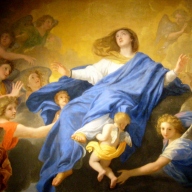





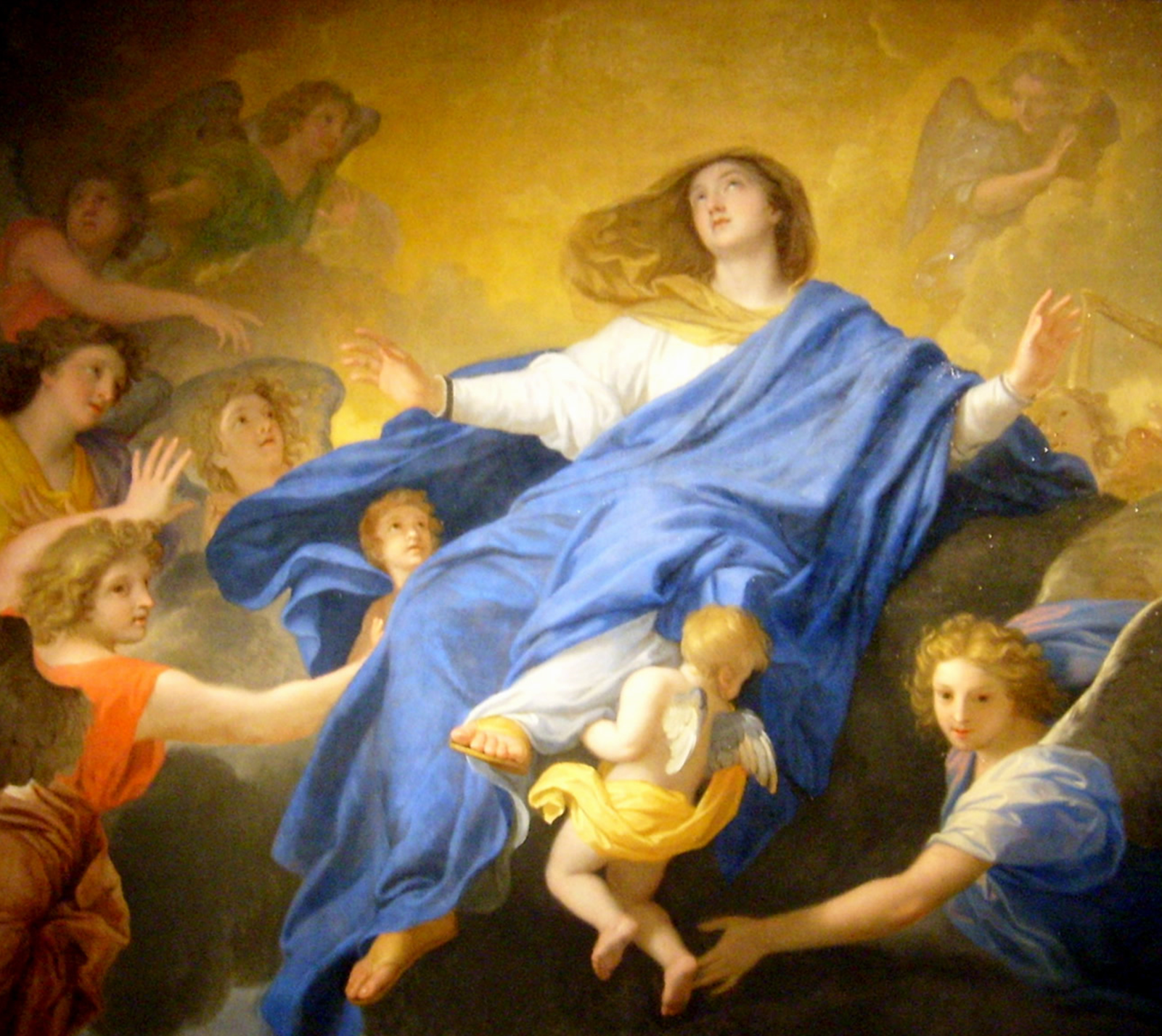
Today we keep the Feast of the Assumption of Our Lady into Heaven. The Scriptures tell us nothing of the end of Our Lady’s life although it is presumed that she lived with St John the Evangelist at Ephesus. From the Fifth Century various accounts appear in writing. In some versions it is said to have taken place in Ephesus, in the House of the Virgin Mary, although this is a much more recent and localized tradition. The earliest traditions all locate the end of Mary's life in Jerusalem. By the 7th century a variation emerged, according to which one of the apostles, often identified as St Thomas, was not present at the death of Mary, but his late arrival precipitates a reopening of Mary's tomb, which is found to be empty except for her grave clothes. In a later tradition, Mary drops her girdle down to the apostle from heaven as testament to the event. This incident is depicted in many later paintings of the Assumption. The taking of Mary into Heaven became an established teaching across the Eastern, Western, Coptic and Oriental churches from at least the late 7th Century, the festival date settling at August 15. Pope Pius XII proclaimed this to be a dogma of the Catholic Faith in 1951 as a spelling out of Christ’s promise that we will share in his Resurrection anticipated for Our Lady by virtue of her Immaculate Conception and life entirely free from sin. Today’s first reading probably had immediately in mind the escape of the Christian community in Jerusalem to the desert across the Jordan at Pella when the Romans besieged and destroyed the Holy City – the Church is seen as the daughter of Jerusalem – but looking back we identify the Church with Our Lady. Her destiny foreshadows ours. Today is also regarded as the Patronal feast day for all churches dedicated in honour of Our Lady without any further specification, e.g. many of our mediaeval village churches.